

The Role of Mock Tests in Preparing for CA Foundation Exams
The Chartered Accountancy journey is a test of resilience, conceptual clarity, and disciplined execution. Entering the CA Foundation level marks your first stepping stone into this prestigious profession. While studying the ICAI syllabus thoroughly is non-negotiable, many hardworking candidates find themselves falling short on exam day simply because they haven’t conditioned their minds for the real pressure of the examination hall. When Preparing for CA Foundation Exams, relying solely on theoretical reading and solving textbook illustrations is only half the battle won. The true differentiator between an average score and an exemplary performance lies in mock tests.
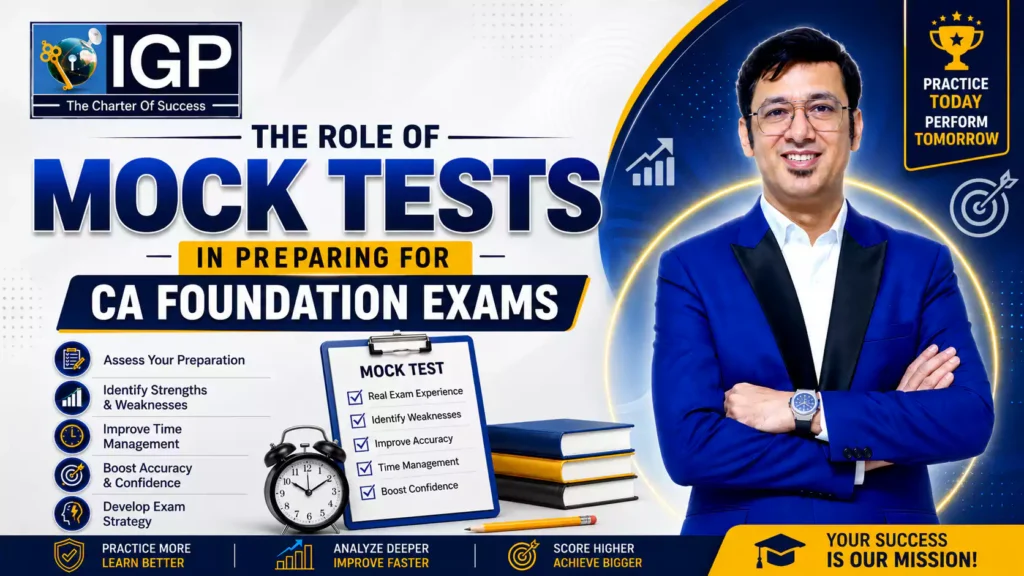
At IGP Institute, our faculty panel has mentored thousands of successful students across our Laxmi Nagar, Janakpuri, and Rohini centers. Over decades of guiding rankers, one pattern remains constant: students who routinely evaluate themselves through structured, exam-like test series consistently outperform those who leave testing for the final days.
Mock tests bridge the gap between knowing the concept and executing it accurately within 180 minutes under strict exam pressure.
Why Mock Tests are Essential in CA Foundation Preparation
A Mock Test Paper (MTP) is not merely a practice exercise; it is a simulation of the ultimate challenge conducted by the Institute of Chartered Accountants of India (ICAI). Attempting well-crafted mock tests transforms your preparation from passive reading to active application.
1. Eliminating Exam-Day Anxiety and Building Exam Temperament
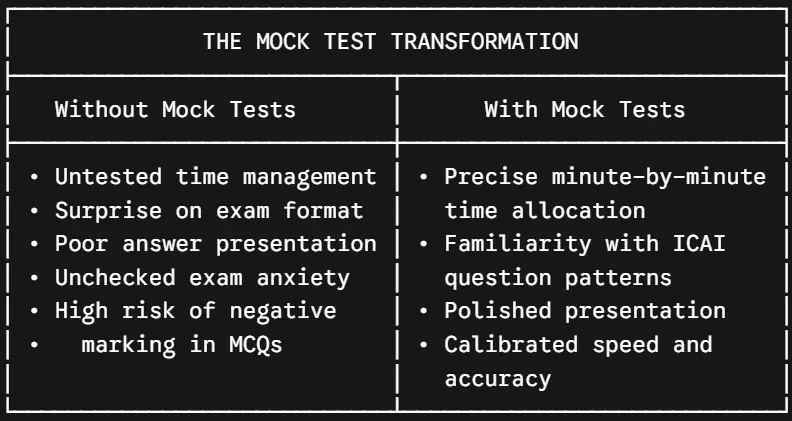
The sheer pressure of the three-hour examination can cause even well-prepared students to freeze up or make silly mistakes. Taking full-length mock tests under timed conditions desensitizes your brain to exam stress. By the time you sit for the actual paper, the experience feels routine rather than intimidating.
2. Mastering Time Allocation Across Subjects
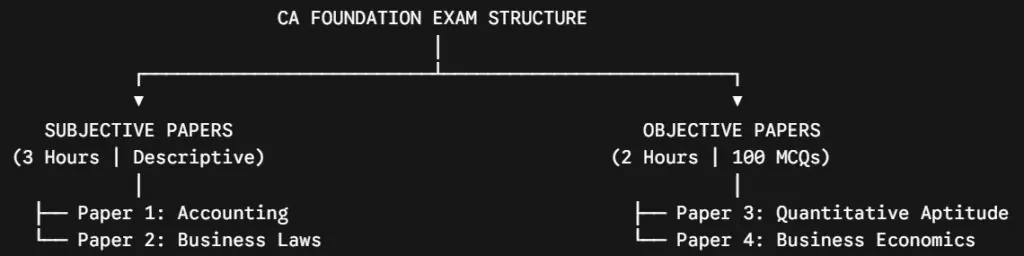
The CA Foundation pattern requires a dual approach:
- Subjective Papers (Accounting & Business Laws): Demand long-form writing, working notes, logical legal reasoning, and neat presentation within 3 hours.
- Objective Papers (Quantitative Aptitude & Business Economics): Test rapid calculation speed, sharp accuracy, and decision-making to avoid negative marking (0.25 mark deduction per incorrect answer).
Mock tests teach you when to move on from a stuck question and how to pace your speed so you complete the paper with 10–15 minutes left for final review.
3. Identifying Knowledge Gaps and Concept Blindspots
Re-reading notes often gives a false sense of mastery known as the illusion of competence. You feel you know the concept because the textbook page looks familiar. When faced with an unseen, integrated question in a mock test, your true retention and application skills are put to the test.
Detailed Breakdown: Subject-Wise Mock Test Strategies
Each of the four papers in the CA Foundation curriculum tests a distinct cognitive skill set. Your strategy for taking mock tests must adapt to the nature of each subject.
Paper 1: Accounting – Precision, Working Notes, and Speed
Accounting is a scoring paper, but lengthiness is its biggest trap. During mock tests, pay close attention to:
- Working Notes: ICAI allocates step-wise marks. Ensure every assumption, calculation, and ledger balance is explicitly supported by neat working notes.
- Format Compliance: Prepare journal entries, ledger accounts, and balance sheets with proper headers and column alignments.
- Question Selection: Utilize the initial 15-minute reading time effectively to select the optional question you can solve fastest and most accurately.
To build a rock-solid daily subject routine alongside your test series, follow our complete guide on CA Foundation Accounts Study Plan.
Paper 2: Business Laws – Section References and Case Study Structure
Law requires precise conceptual drafting rather than casual explanations. When attempting Law mock tests:
- Structure Your Case Law Answers: Use the classic 4-part structure:
- Provision: Cite the relevant Act and Section number (only if 100% sure).
- Facts of the Case: Briefly summarize the core issue in 2–3 lines.
- Analysis: Apply the legal provision directly to the facts.
- Conclusion: State a clear, unequivocal legal verdict.
- Technical Terminology: Avoid colloquial language; substitute with precise legal terms (e.g., consensus ad idem, void ab initio, quid pro quo).
For a step-by-step breakdown of how to structure your daily law revisions and master case study writing, refer to our CA Foundation Law Study Plan.
Paper 3: Quantitative Aptitude – Speed, Shortcuts, and Accuracy
Quantitative Aptitude (Business Mathematics, Logical Reasoning, and Statistics) requires razor-sharp problem-solving speed:
- Round-Based Solving Strategy:
- Round 1 (0 to 45 mins): Solve all direct, formula-based, and easy Logical Reasoning questions first.
- Round 2 (45 to 90 mins): Attack moderately lengthy calculations.
- Round 3 (Last 30 mins): Address tough or tricky problems.
- Negative Marking Awareness: If you cannot narrow down an MCQ to two options, skip it. Blind guessing ruins an otherwise aggregate-clearing score.
Paper 4: Business Economics – Conceptual Clarity and Graph Interpretation
Economics demands dynamic conceptual understanding. In mock tests:
- Focus on Key Nuances: Differentiate clearly between shift vs. movement in demand, elasticities, market structures, and national income accounting.
- Avoid Over-Thinking: Objective questions in Economics are straight to the point. Trust your initial concept application rather than second-guessing clear options.
To align your macro and microeconomics coverage with periodic practice papers, check out our structured CA Foundation Economics Study Plan.
How Toppers Use Mock Tests Differently
When analyzing the habits of high achievers at IGP Institute, we observe a clear pattern in how rankers approach test series. Toppers do not view a mock test as the end of a study module; they treat it as the beginning of an intense feedback loop.
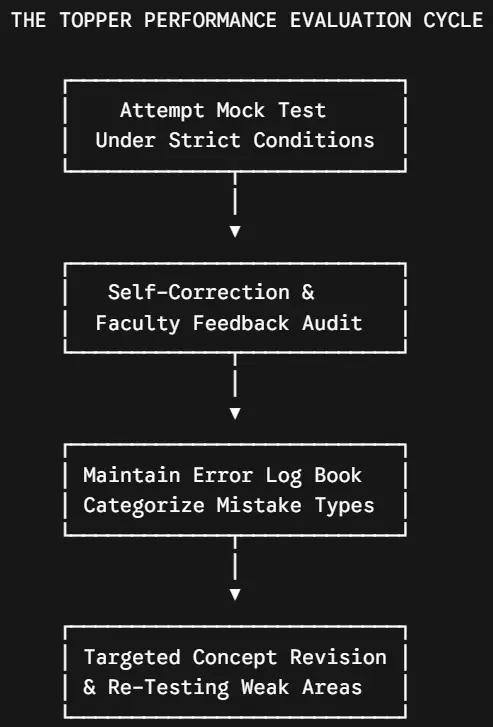
When Preparing for CA Foundation Exams, adopting a topper’s evaluation framework will accelerate your progress:
- The Error Log System: Maintain a dedicated notebook titled “My Exam Errors.” After every mock test, classify every lost mark into one of three buckets:
- Conceptual Error: You didn’t understand or remember the core rule (Requires immediate notes review).
- Presentation / Calculation Error: You knew the concept but made a ledger/working note slip (Requires deliberate practice).
- Time / Panic Error: You ran out of time or misread the question prompt (Requires mock conditioning).
- Simulating Real Exam Conditions: Attempt tests strictly between 2:00 PM and 5:00 PM. Your brain develops an internal circadian rhythm that peaks during those exact three hours.
- Evaluating Against Suggested Answers: Don’t just check your total marks. Compare your answer sheet side-by-side with ICAI’s suggested answers to see exact wordings, presentation standards, and step-marking allocations.
For an end-to-end blueprint on scheduling your overall timetable, subject rotation, and revision cycles, explore our comprehensive CA Foundation 2026 Preparation Strategy.
To dive deeper into the specific study habits, note-making styles, and paper-solving techniques of top rankholders, read our detailed guide on CA Foundation Topper Strategy.
Structured Mock Test Timeline: From First Draft to Exam Day
To maximize the benefits of test series, space them strategically throughout your preparation cycle rather than cramming them in the final fortnight.
| Stage | Preparation Phase | Mock Test Type & Frequency | Core Focus |
| Phase 1 | Syllabus Coverage (50%–70% Completed) | Chapter-Wise Tests (After completing 2-3 chapters) | Testing granular understanding, formula retention, and basic presentation. |
| Phase 2 | Full Syllabus Completion | Unit / Half-Syllabus Tests (Every weekend) | Managing time across combined chapters and testing inter-topic connections. |
| Phase 3 | Final 30–45 Days Before Exam | Full-Length 100-Mark MTPs (2 to 3 full series) | Exam-hall simulation, 3-hour stamina, question selection, and speed refinement. |
Common Mistakes Students Make During Mock Tests (And How to Avoid Them)
- Waiting for “100% Syllabus Completion”: No CA aspirant ever feels 100% prepared. If you have covered 70–80% of a syllabus block, start taking tests. Delaying tests until you feel “perfect” usually leads to taking zero tests.
- Ignoring the Post-Test Analysis: Attempting a test and filing away the result without analyzing your mistakes is a wasted effort. Spend at least 60–90 minutes reviewing every evaluated paper.
- Cheating on Time Limits: Extending your test time by 15–20 minutes at home creates a false illusion of speed. When the timer hits 3 hours, stop writing immediately.
- Neglecting Presentation in Practice: Writing illegibly or skipping formats during home practice forms bad muscle memory that carries directly into the exam hall.
Accelerate Your Success with IGP Institute’s Evaluated Test Series
At IGP Institute, we believe that high-quality evaluation is the backbone of professional test preparation. Our carefully curated CA Foundation Mock Test Series mirrors ICAI’s exact level of difficulty, layout, and marking scheme.
- Expert Faculty Panel: Designed by top educators to test high-weightage and tricky topics.
- Detailed Evaluated Answer Sheets: Evaluated with step-by-step feedback so you know exactly where marks were lost and how to claim them back.
- Personalized Mentorship: Faculty guidance across our Laxmi Nagar, Janakpuri, and Rohini centers to help you refine your strategy.
While Preparing for CA Foundation Exams, remember that every error you commit and fix in a mock test is one less error on your official ICAI scorecard. Treat every practice test as a stepping stone toward your ultimate goal: passing CA Foundation in your very first attempt!










Leave a Reply