
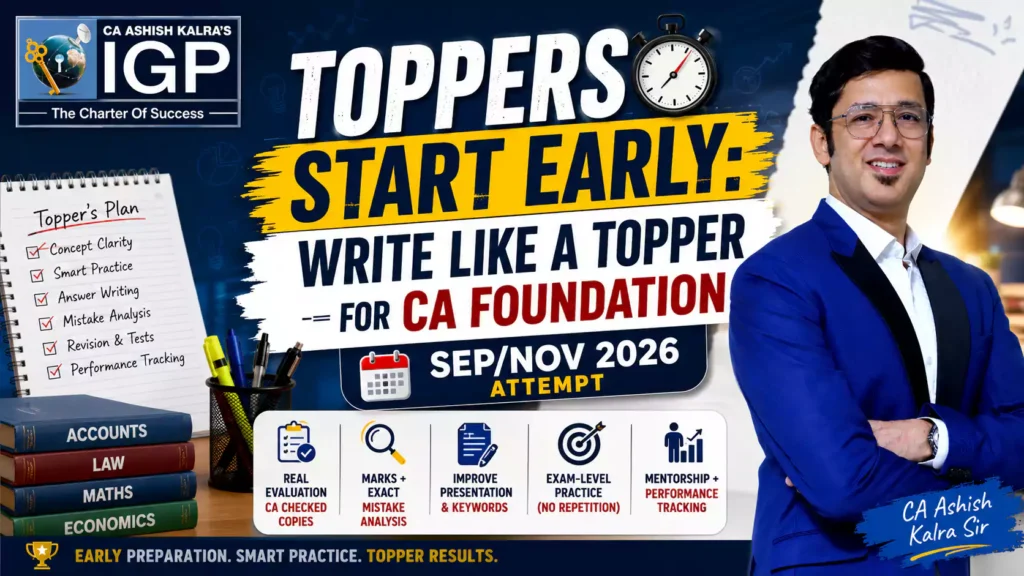
Toppers Start Early: Write Like a Topper for CA Foundation Sep & Nov 2026 Preparation
Preparing for the CA Foundation exam is not only about studying hard. Every year, thousands of students spend long hours studying books, attending coaching classes, reviewing notes, and taking mock tests — yet only a small percentage manage to score exceptionally well.
Why?
Because toppers do something different.
They do not simply “study more.”
They prepare smarter.
They start earlier.
They analyse mistakes faster.
They improve presentation.
They understand ICAI expectations.
And most importantly, they continuously evolve after every test.
If you are preparing for the CA Foundation Sep/Nov 2026 attempt, this article is not another motivational speech. This is a practical roadmap to help you think, write, and improve like a topper.
Whether you are an average student, a school topper, or someone restarting preparation after disappointment, the right strategy can completely change your results.
Why CA Foundation Is Different from School Exams
Many students enter CA Foundation with a school mindset:
- Read chapters repeatedly
- Highlight notes
- Memorize answers
- Solve selective questions
- Study only before exams
This approach fails in professional exams.
CA Foundation tests:
- conceptual clarity
- application ability
- presentation quality
- accuracy under pressure
- time management
- consistency
The ICAI examiner does not know:
- How many hours did you study?
- How stressed were you?
- How many coaching classes have you attended?
The examiner only checks:
- What did you write?
- How did you write it?
- Whether your answer matches professional standards
That is why answer-writing practice and evaluation become critical.
Toppers Start Early — And There’s a Reason
One of the biggest mistakes students make is delaying serious preparation.
Many students think:
“I still have time.”
“I’ll start after boards.”
“I’ll prepare properly 3 months before exams.”
But toppers understand something important:
Improvement Needs Time
You cannot improve:
- answer presentation
- speed
- conceptual clarity
- writing structure
- MCQ accuracy
- revision quality
overnight.
Real improvement happens in cycles.
What Happens When You Start Early?
| Area | Late Starters | Early Starters |
|---|---|---|
| Concept Clarity | Weak | Strong |
| Revision Cycles | 1-2 | 4-6 |
| Mock Test Practice | Limited | Extensive |
| Mistake Analysis | Minimal | Continuous |
| Confidence Level | Unstable | Consistent |
| Presentation Skills | Average | Professional |
| Exam Pressure | Very High | Controlled |
Toppers use early preparation to:
- identify weaknesses
- improve answer writing
- fix conceptual gaps
- develop consistency
- build exam temperament
This is the real difference.
The Biggest Secret of Toppers: They Learn from Every Mistake
Average students repeat mistakes.
Toppers track mistakes.
This single habit changes everything.
After every:
- mock test
- practice paper
- class test
- revision test
top-performing students ask:
- Why did I lose marks?
- Was the concept weak?
- Did I miss keywords?
- Was my presentation poor?
- Did I write irrelevant content?
- Did I mismanage time?
- Did I misunderstand the question?
This creates continuous improvement.
Your Mistakes Are Actually Your Growth Report
Most students fear mistakes.
Toppers treat mistakes like data.
Every wrong answer tells you:
- What needs revision
- Where concepts are weak
- Which chapter needs attention
- Whether your writing style is effective
- Whether your preparation strategy is working
The earlier you discover mistakes, the easier they are to fix.
That is why serious students begin testing themselves early.
Write Like a Topper — Not Like a School Student
This is one of the most important sections of this article.
Many students know the answers but still score poorly because their presentation is weak.
Remember:
In professional exams, presentation affects marks.
Two students may know the same concept, but the student who presents better usually scores higher.
What Does “Write Like a Topper” Actually Mean?
It means:
- writing structured answers
- using ICAI language
- highlighting keywords
- maintaining neat presentation
- following proper formats
- using working notes correctly
- answering exactly what is asked
Example: Weak vs Strong Presentation
Weak Answer Style
- Long paragraphs
- No headings
- No keywords
- Untidy calculations
- Irrelevant explanations
- Missing formats
This confuses the examiner.
Topper-Style Answer
- Proper headings
- Stepwise explanation
- Important keywords highlighted
- Professional format
- Clean calculations
- Point-wise writing
This improves readability and scoring potential.
Important Presentation Habits That Increase Marks
1. Use Proper Headings
Headings make answers easy to evaluate.
Example:
- Meaning
- Features
- Advantages
- Calculation
- Conclusion
2. Highlight Keywords
ICAI examiners look for technical terms.
For example:
- Prudence Concept
- Capital Expenditure
- Revenue Recognition
- Partnership Deed
- Material Misstatement
Highlighting keywords improves visibility.
3. Maintain Working Notes
Especially important in:
- Accounts
- Maths
- Statistics
Working notes show method marks.
4. Write Stepwise Calculations
Never overcrowd calculations.
Presentation matters.
5. Avoid Overwriting
Professional answers are:
- concise
- relevant
- structured
Not unnecessarily lengthy.
Real Evaluation Changes Everything
One of the biggest problems in self-study is this:
Students do not know how ICAI would evaluate their answers.
You may think your answer is correct.
But actual evaluation may reveal:
- missing formats
- incomplete logic
- weak presentation
- poor structure
- missing keywords
- calculation mistakes
- time management issues
That is why real answer-sheet evaluation becomes extremely powerful.
Why CA Checked Copies Matter
When experienced faculty or CA evaluators check your copies, they identify:
- exact mistakes
- answer-writing gaps
- conceptual weaknesses
- repeated errors
- presentation problems
This creates targeted improvement.
Without evaluation, students often continue repeating the same mistakes for months.
What Serious Evaluation Should Include
1. Exact Mistake Analysis
Not just marks.
Students should know:
- where marks were lost
- why marks were deducted
- how answers could improve
2. Conceptual Weakness Identification
Sometimes the issue is not writing.
The real issue is incomplete understanding.
Proper evaluation identifies:
- weak chapters
- confusion areas
- application problems
3. Presentation Improvement Guidance
Students should learn:
- answer structuring
- keyword usage
- professional formatting
- professional formatting
4. Performance Tracking
One test is not enough.
Improvement should be tracked over time.
Why Performance Tracking Is Important
Most students prepare emotionally.
Toppers prepare analytically.
They track:
- subject-wise marks
- chapter-wise weaknesses
- accuracy percentage
- revision efficiency
- test performance trends
This helps them improve strategically.
Example of Smart Performance Tracking
| Test | Accounts | Law | Maths | Economics | Total |
|---|---|---|---|---|---|
| Test 1 | 42 | 38 | 45 | 40 | 165 |
| Test 2 | 51 | 49 | 52 | 47 | 199 |
| Test 3 | 61 | 56 | 60 | 54 | 231 |
This type of tracking:
- builds motivation
- reveals progress
- identifies weak areas early
Exam-Level Practice Is Non-Negotiable
Reading alone is not preparation.
Real preparation means:
- writing under time pressure
- solving unfamiliar questions
- imp ving accuracy
- handling pressure
- managing speed
The Biggest Mistake Students Make During Practice
They repeatedly solve:
- familiar questions
- repeated examples
- comfortable chapters
This creates false confidence.
Real exam-level practice means:
- new questions
- mixed concepts
- time-bound solving
- pressure handling
No Repetition Strategy: What Toppers Do
Toppers avoid wasting time on:
- unnecessary repetition
- passive reading
- over-highlighting notes
Instead, they focus on:
- active recall
- timed practice
- weak-area correction
- smart revision
The Ideal Preparation Cycle for CA Foundation 2026
Step 1: Learn Concepts
Understand the basics properly.
Do not memorise blindly.
Step 2: Solve Questions
Apply concepts immediately.
Step 3: Write Tests
Without testing, preparation remains incomplete.
Step 4: Get Evaluated
Discover mistakes early.
Step 5: Improve Weak Areas
Focused correction matters more than random studying.
Step 6: Repeat the Cycle
This creates continuous growth.
Subject-Wise Smart Strategy for CA Foundation
Accounts
Focus Areas
- journal entries
- rectification
- final accounts
- depreciation
- partnership basics
Scoring Secret
Presentation + working notes + formats.
Law
Focus Areas
- contract act
- LLP
- company law basics
Scoring Secret
Keywords and legal language.
Writing random theory reduces marks.
Maths, LR & Statistics
Focus Areas
- practice consistency
- speed
- calculator discipline
Scoring Secret
Timed practice.
Maths improves through repetition and accuracy.
Economics
Focus Areas
- conceptual clarity
- graphical understanding
- practical application
Scoring Secret
Understanding instead of rote learning.
The Psychology of Toppers
Toppers are not always the most intelligent students.
Usually, they are:
- more disciplined
- more consistent
- more self-aware
- more adaptable
They:
- start early
- avoid excuses
- track improvement
- remain coachable
What Average Students Usually Do Wrong
1. Delayed Preparation
Starting late creates panic.
2. No Testing
Students study without checking their performance.
3. Ignoring Presentation
Good content with poor presentation loses marks.
4. Fear of Mistakes
Mistakes are necessary for growth.
5. Passive Learning
Watching lectures continuously without writing practice is dangerous.
How to Build Topper-Level Discipline
Daily Study Targets
Avoid vague goals like:
“Today I’ll study a lot.”
Instead:
- Chapter completion
- 50 MCQs
- 2 answer-writing questions
- 1 mock test section
Specific goals improve productivity.
Follow the 3R Formula
Read
Understand concepts.
Revise
Strengthen memory.
Reproduce
Write answers without seeing notes.
This third step is where toppers separate themselves.
How Mentorship Accelerates Improvement
Self-study is valuable.
But mentorship reduces:
- confusion
- direction problems
- repeated mistakes
- strategy errors
Good mentorship provides:
- accountability
- clarity
- performance analysis
- improvement planning
Why Many Hardworking Students Still Fail
Because hard work without correction becomes repetition.
Students may:
- Study 10 hours daily
- Solve hundreds of questions
- Attend classes regularly
Yet continue repeating:
- conceptual mistakes
- writing errors
- time-management problems
That is why evaluation and guidance matter.
The Role of Mock Tests in CA Foundation Success
Mock tests help students:
- simulate exam pressure
- improve speed
- increase accuracy
- build confidence
- improve time allocation
But simply attempting tests is not enough.
The real growth happens AFTER the test.
That means:
- Reviewing errors
- Analysing weak chapters
- Correcting presentation
- Rewriting poor answers
How ICAI Actually Rewards Students
ICAI rewards:
- Clarity
- Precision
- Presentation
- Conceptual understanding
- Proper formats
Not decorative handwriting.
Professional writing matters more than stylish writing.
The Importance of Revision Cycles
One revision is never enough.
Toppers revise repeatedly.
Suggested Revision Structure
| Timeline | Focus |
|---|---|
| First Reading | Understanding |
| First Revision | Concept strengthening |
| Second Revision | Speed improvement |
| Third Revision | Weak area correction |
| Final Revision | Exam simulation |
Smart Students Focus on Improvement, Not Perfection
Perfection delays progress.
Top-performing students focus on:
- consistent growth
- mistake reduction
- answer quality improvement
Even small improvements every week create massive results over time.
How to Stay Consistent till Sep/Nov 2026
Long-term preparation requires:
- discipline
- realistic schedules
- balanced routine
- regular testing
- periodic revision
Avoid:
- burnout
- comparison
- panic studying
A Practical Weekly Routine for CA Foundation Students
| Day | Focus |
|---|---|
| Monday | New concepts |
| Tuesday | Practice questions |
| Wednesday | Answer writing |
| Thursday | MCQs + revision |
| Friday | Mock test |
| Saturday | Mistake analysis |
| Sunday | Weak area improvement |
This type of structure improves retention and performance.
Final Message for CA Foundation Sep/Nov 2026 Students
If you truly want to score well in CA Foundation, remember this:
Studying is not enough anymore.
You must:
- write better
- analyze mistakes
- improve continuously
- practice under pressure
- learn exam presentation
- track performance seriously
The earlier you start, the more time you get to improve.
And improvement is what creates toppers.
Conclusion
“Toppers Start Early” is not just a motivational line.
It is a strategy.
Students who begin early get time to:
- improve concepts
- strengthen writing
- fix mistakes
- develop confidence
- build exam temperament
If you are preparing for the CA Foundation Sep/Nov 2026 attempt, start acting like a topper from today itself.
Do not wait for the exam to discover your weaknesses.
Discover them now.
Correct them now.
Improve now.
Because the students who succeed in professional exams are not the ones who avoid mistakes.
They are the ones who learn from every single one of them.








Leave a Reply